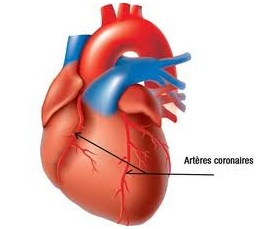
The heart is a muscular contractile organ supplied with blood through vessels called coronary arteries. There are two main coronary arteries:
Left coronary artery
This artery bifurcates into the anterior interventricular artery and the left circumflex artery. The anterior interventricular artery runs between the left and right ventricles. The circumflex artery, on the other hand, wraps around the heart (as its name suggests), giving rise to the obtuse marginal arteries.
Right coronary artery
This artery supplies blood to the right side of the heart.
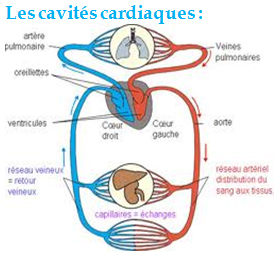
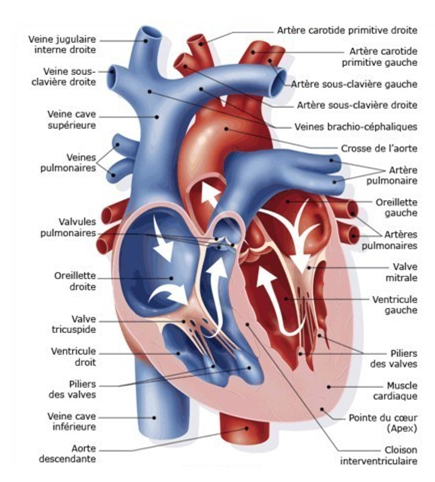
The heart is made up of four chambers.
The right atrium receives oxygen-depleted blood, known as venous blood, from the peripheral tissues.
The right ventricle then pumps this blood towards the lungs, where it is oxygenated.
The left atrium receives red oxygen-rich blood coming from the lungs.
Finally, the left ventricle pumps the red, oxygen-rich blood back out to the peripheral tissues.
Heart valves
Valves separate these various heart chambers to ensure that blood flows in only one direction:
The tricuspid valve lies between the right atrium and the right ventricle.
The pulmonary valve lies between the right ventricle and the pulmonary artery.
The mitral valve lies between the left atrium and the left ventricle.
The aortic valve lies between the left ventricle and the aorta, which pumps blood towards the peripheral tissues.
The right and left heart chambers are separated by two impermeable walls: the interatrial septum and the interventricular septum.
Nous utilisons des cookies pour vous garantir la meilleure expérience sur notre site web. Si vous continuez à utiliser ce site, nous supposerons que vous en êtes satisfait.